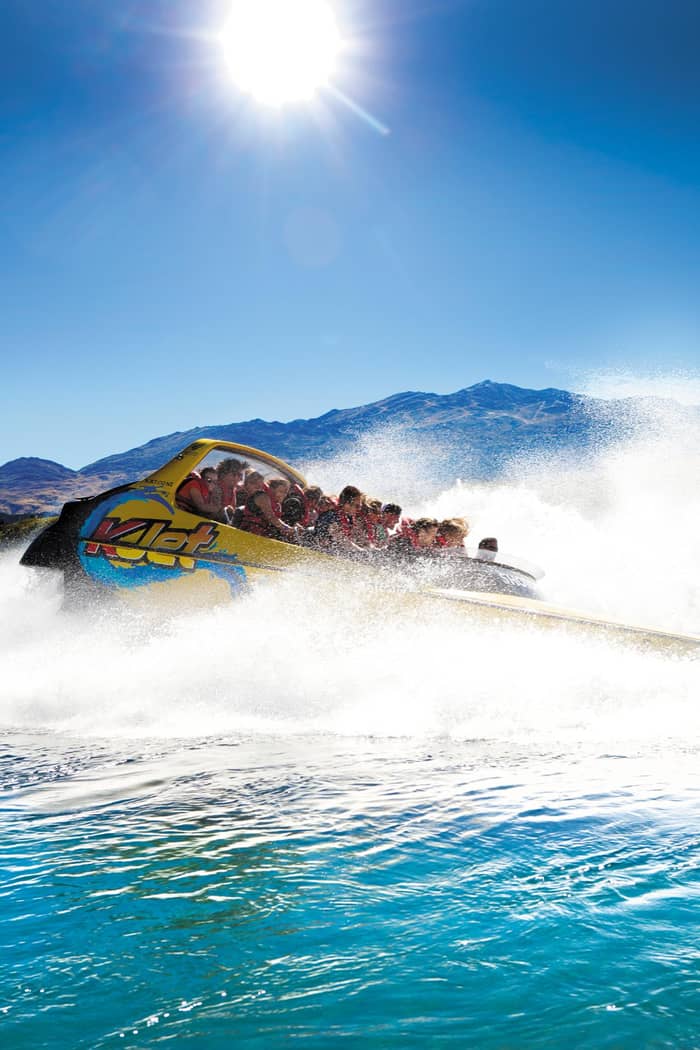
Longest ride
Town lake and rivers
Lake, Kawarau, Shotover
- Length1 hour
- Top speed95 km/h
- WaterLake and braids
Guides
Language
Currency
See what is openfrom $87 · cancelling is freeHelp with your choice
Jet boat ride on the lake, the Kawarau and the Shotover, 1 hour
★ 4.8 · 1,959 reviews total
The short version
A jet boat works by sucking water in through an intake flush with the hull and firing it out of a steerable nozzle at the stern, so nothing hangs below to hit the riverbed.
Key numbers
Two taps to your river
Say what you want to feel and how much time you have, and a matching listing appears with its from-price.
Best match for you
from $87
It lasts 1 hour from the town pier and skims the shallow Shotover braids.
Best match for you
from $117
It runs the narrow canyons at Arthurs Point at up to 90 km/h.
Best match for you
from $123
A 3-hour trip: the hand-cut road in, then the upper Shotover gorges.
Best match for you
from $88
A 15-minute dash around a racing course; minimum height 1.2 metres.
How does a jet boat work when there is no propeller hanging under it? Here is the pump, the nozzle and the spin in plain words, the Canterbury farmer behind it, and what it all means on a Queenstown river.
Editorial team, queenstownjetboat.quest · Updated November 8, 2026 · Reading: 8 min
The essentials
The jet boat began with a practical itch. Tourism New Zealand credits its development in the 1950s to a New Zealand farmer, William (Bill) Hamilton, who wanted to run the shallow rivers of Canterbury.4 Those rivers are wide, braided and stony, and a normal propeller would be smashed on the first gravel bar. A boat that could skim them would open up valleys that were otherwise days of walking away.
Hamilton was born at Ashwick Station near Fairlie on July 26, 1899, and grew up among exactly those rivers.6 By 1939 he had formed the engineering company that still carries his name, working out of the workshop at Irishman Creek Station.7 He was the kind of inventor who built his own tools when the bought ones failed, and the river boat became the project that defined him and his workshop for decades.
His first attempts did not work. HamiltonJet's own history records that in 1951 he returned to the idea of a boat for the shallow rivers near Irishman Creek, trying an air screw and a retractable marine propeller before giving both up.8 It is worth remembering that failure when you sit in a modern jet boat: the clever part is not speed but the fact that nothing sticks out under the hull to hit the riverbed.
Jet against propeller
| Feature | Jet boat | Propeller boat |
|---|---|---|
| What pushes it | Water fired from a nozzle | A spinning propeller |
| Under the hull | Intake flush with the bottom | Shaft, propeller and rudder |
| Shallow water | Runs over gravel at speed | Needs depth below |
| Steering | Swivelling nozzle | Rudder |
| Braking | Reverse bucket over the jet | Reverse gear |
| Best water | Braided rivers and rapids | Calm, flat water |
Jet features as HamiltonJet and Shotover Jet describe them.3,2,21,22
Hamilton did not start from nothing. In the early 1950s he followed the American Hanley hydrojet, which used a pump to draw water in and push it out through a steerable nozzle.13 His first version used a round centrifugal pump that fired water out under the boat and reached a modest 11 miles per hour.14 It moved, but slowly, and the nozzle still sat beneath the hull where rocks could reach it.
The breakthrough came in 1954, when the jet stream was moved so that it left the boat above the waterline.9 Speed rose to 17 mph and every underwater appendage disappeared.9 The first unit of that kind was named Quinnat, a vertical-shaft centrifugal pump driven through a right-angle gearbox.15 Its first trials took place on the dam and water race at Irishman Creek; then, early in 1954, it made a slow but successful run up the Waitaki River.16
Hamilton was modest about all this. He often said he had not invented the waterjet at all and handed the honour to Archimedes.17 That is fair in a way: pumping water to push a boat is an old idea. What he did was make it rugged, simple and shallow enough to work on real New Zealand rivers, and that is the version every Queenstown boat still uses. Next time a driver says the boat was invented here, that is the story behind it.
So how does a jet boat work once you are on board? Shotover Jet describes it plainly: water is drawn in through intakes in the bottom of the boat, internal propellers inside the jet units compress it, and it is driven out of nozzles at the stern at nearly 400 litres per second per unit.1 The push you feel in your back is the reaction to that stream of water leaving the boat, not a propeller biting the river.
The numbers on a canyon boat are hefty. Shotover Jet lists two 350 Mercruiser V8 engines making 700 horsepower between them, feeding two Hamilton 212 jet units that move 760 litres of water a second.24 Picture a large bathtub of water every fraction of a second, hurled backward. That is why acceleration from rest feels abrupt, and why drivers warn you to hold the rail before they open the throttle.
Steering is just as direct. The driver turns the nozzles, changing the direction of the water leaving the stern, and the boat follows.2 Deflectors and thrust buckets drop over the stream to brake or reverse, much as reverse thrust works on a jet aircraft.2 HamiltonJet adds that its units can power-brake at speed, which explains how a boat can stop short of a rock wall in a distance that would surprise a car driver.21
Feel the machine
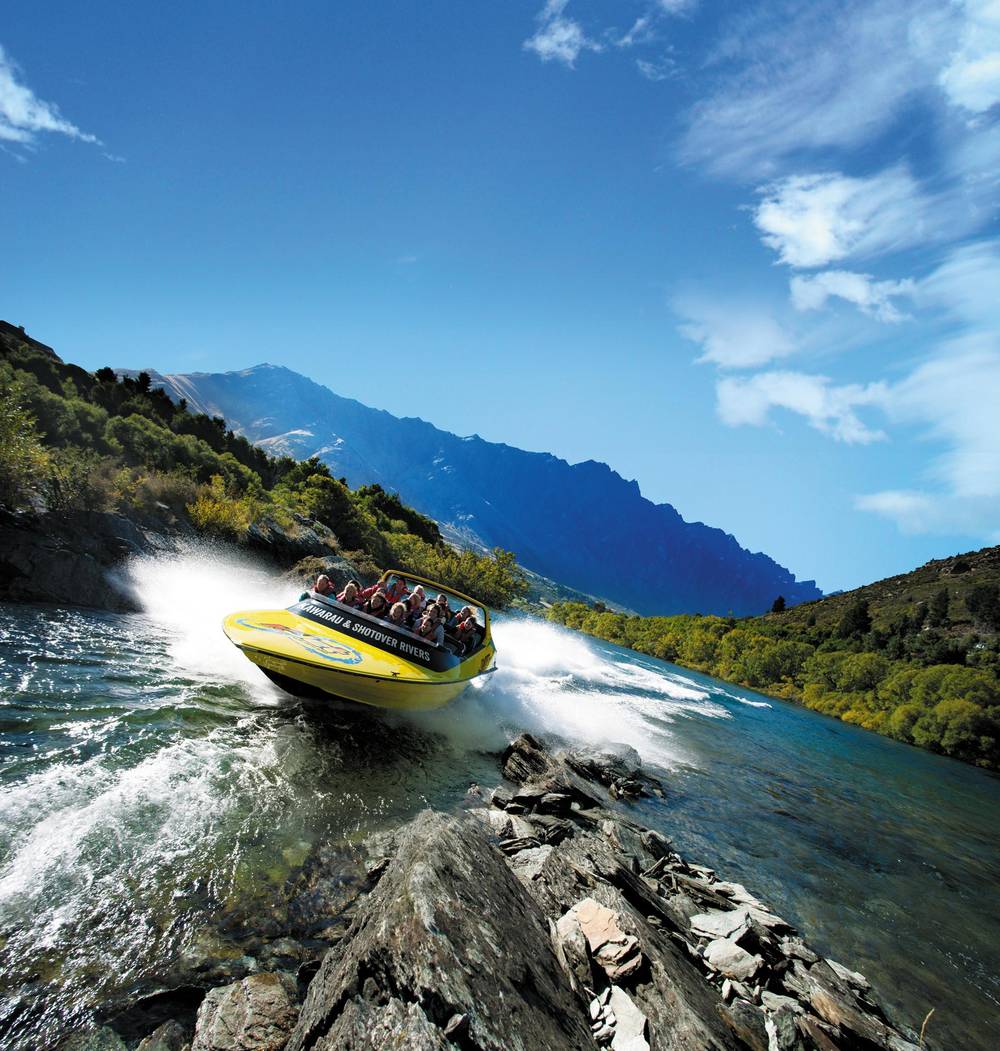
Longest ride
Lake, Kawarau, Shotover
Canyon walls
Narrow rock gorges
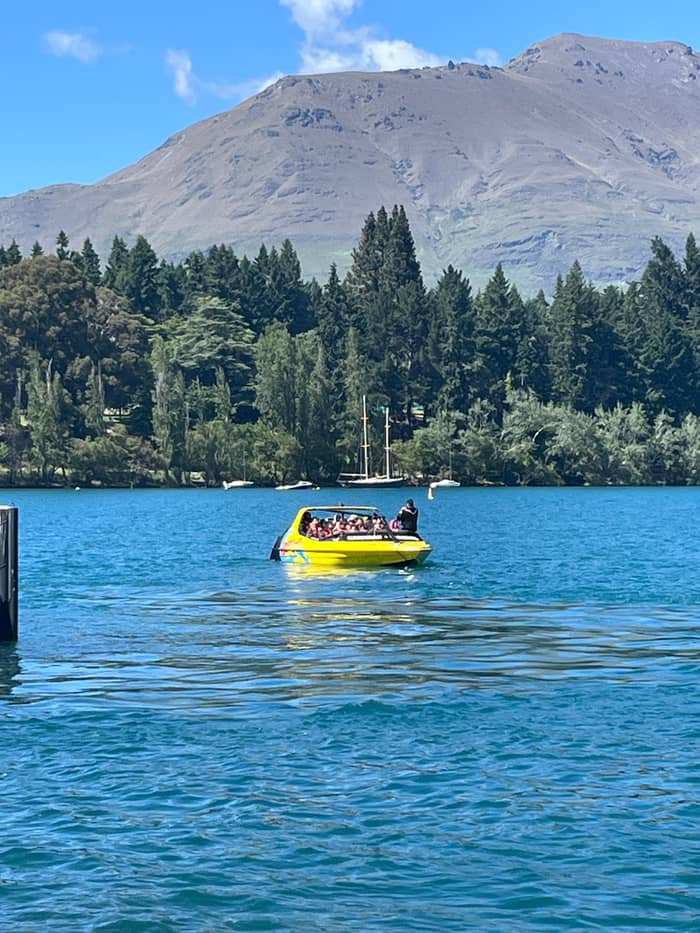
Short and sharp
A racing course
The single most asked question after a ride is how shallow can a jet boat go, and the honest answer depends on the boat. The principle is the same everywhere: HamiltonJet's intake sits flush with the hull bottom, so the boat can reach shallow water and even land on a beach without damaging its drive.3 With no propeller, rudder or shaft below, a jet boat on the plane rides on a thin film of water.
Operators quote their own figures. Shotover Jet says its boats can manoeuvre in water as shallow as 10 cm in the canyons.26 KJet goes further for the braids of the lower Shotover, saying its boats run in water less than 5 cm deep because the jet unit is flush with the underside.23 Both are talking about a boat already skimming at speed; at a standstill any hull sits deeper, so drivers keep moving when the water gets thin.
There is a safety side to the design too. HamiltonJet notes that having no underwater appendages lowers drag and makes the boat safer around people and wildlife in the water.27 Shotover Jet puts the contrast simply: a propeller boat works best on calm, flat water.22 On a lake that is fine; on a river where the bed changes after every flood, it is the jet that keeps going while a propeller boat would be stuck on the first shingle bar.
Price a ride
Set your group size and compare a long ride, a canyon run and a sprint.
Compare 3 alternatives
Set your group size and compare a long ride, a canyon run and a sprint.
≈
View≈
View≈
ViewCurrency conversion uses the ECB reference rate on GetYourGuide from-prices. The exact price is displayed when you book.
From workshop to river
1951
Air screw and propeller ideas fail.8
1954
Speed reaches 17 mph, no appendages.9
1957
An axial-flow unit, far more efficient.10
1958
First jet run through the Kawarau Falls dam.5
1960
First up-run through the canyon.11
1963
A simpler design halves the cost.12
People also want to know how fast can jet boats go, and in Queenstown the operators give their own top speeds. KJet quotes up to 95 kph on its lake and river loop.18 Shotover Jet gives up to 90 kph in the canyons.19 Skippers Canyon Jet says its drivers run in excess of 80 kmh up the upper Shotover.20 Close to rock walls, even the lowest of those feels absurdly fast, and the numbers matter less than how near the scenery passes.
Speed on the water feels different from speed on a road. The boat sits low, spray fills the edges of your vision and the banks are close, so a fast run beside a cliff feels quicker than any motorway. HamiltonJet describes its waterjets as suited to planing boats in the 20 to 50+ knot range, which covers everything you will ride in Queenstown.28 Your driver will rarely hold top speed for long; the river decides.
The spin is the trick everyone remembers. With nothing under the hull to grip the water, the driver can swing the nozzle hard, chop the throttle and let the boat pivot around on the surface, throwing a sheet of spray over the side. KJet says its whole fleet is designed for full 360-degree spins.25 On the Dart River, for one, the drivers warn you before every spin so you can tuck a camera away and brace.29
Video
EngineBlockTV on YouTube · Until you tap play, no video is loaded.
The HamiltonJet intake is flush with hull bottom to allow access to shallow water areas and beach landings with no risk of damage to the propulsion drive.
On board
The design kept improving quickly. The first Rainbow units appeared in 1956, and about 100 were made and sold in New Zealand.30,31 In 1957 came the Chinook, a twin-impeller axial-flow unit that pushed water straight through and was far more efficient.10 In 1963 the Colorado series simplified the design so much that it halved the cost of a unit.12 Each step made the boats cheaper, lighter and better on rough water.
The machine soon proved itself far from home. In 1960 his son Jon played a key part in the Colorado River expedition that became the first to journey upstream through the Grand Canyon.11 In the 20 years that followed, jet boats went up the Sun Kosi, the Sepik, the Zaire, the Ganges and the Amazon.32 A farm workshop idea had become the way to reach places no other boat could, from Himalayan rivers to tropical floodplains.
Bill Hamilton was knighted in 1974 for services to manufacturing and died on March 30, 1978.33,34 The company he started says it has now installed over 60,000 waterjets worldwide, in ferries, rescue boats and patrol craft as well as river runners.35 The boats you see in Queenstown are the most visible part of that legacy, but far from the largest; the same idea now moves ferries carrying commuters.
Queenstown turned the invention into an attraction. The town's first commercial jet runs started in 1958, when Kawarau Jet Services took a brand-new Hamilton Jet 30 through the Kawarau Falls dam.5 Shotover Jet followed in 1965 with Jet 30 boats that carried 5 passengers and took 1,480 riders in its first year.36 KJet says it was also the first to fit roll bars, and that it introduced twin-engine jet boats in 1995, another first.37,38
The next change is under way. Shotover Jet's electric jet boat project began in 2019, and the boat was first tested on Lake Wakatipu at Glenorchy in May 2022.39,40 Many parts carry straight over from petrol boats, including the water jet units themselves.41 Ngāi Tahu Tourism reports a full conversion of a former petrol boat to 100 percent electric drive.42 The pump and nozzle stay the same; only what turns them changes.
There is also a racing branch. Jet sprint is a timed dash around a tight course of channels, and you can try a taste of jet sprint in Queenstown at Oxbow Adventure, where the listed ride lasts 15 minutes and needs a minimum height of 1.2 metres. It shows the same machine at its most extreme: tiny boats, huge power and corners taken faster than seems possible. Watch from the side first if you are unsure; it is a spectacle in itself.
FAQ
Water is drawn in under the hull and fired out of nozzles at the stern at nearly 400 litres a second per unit.1
Tourism New Zealand credits the Canterbury farmer with developing it in the 1950s.4
Deflectors and thrust buckets let it brake and reverse.2
With no rudder or propeller under the hull, the boat pivots on the surface; KJet's fleet is built for full 360-degree spins.25
That year Kawarau Jet Services took a jet boat through the old Kawarau Falls dam for the first time.5
Sources
More to read
Not sure which Queenstown river ride suits you? Ask a real person here.